

The Canopy and the Umbrella: Rethinking the Numinous in a Plural Age
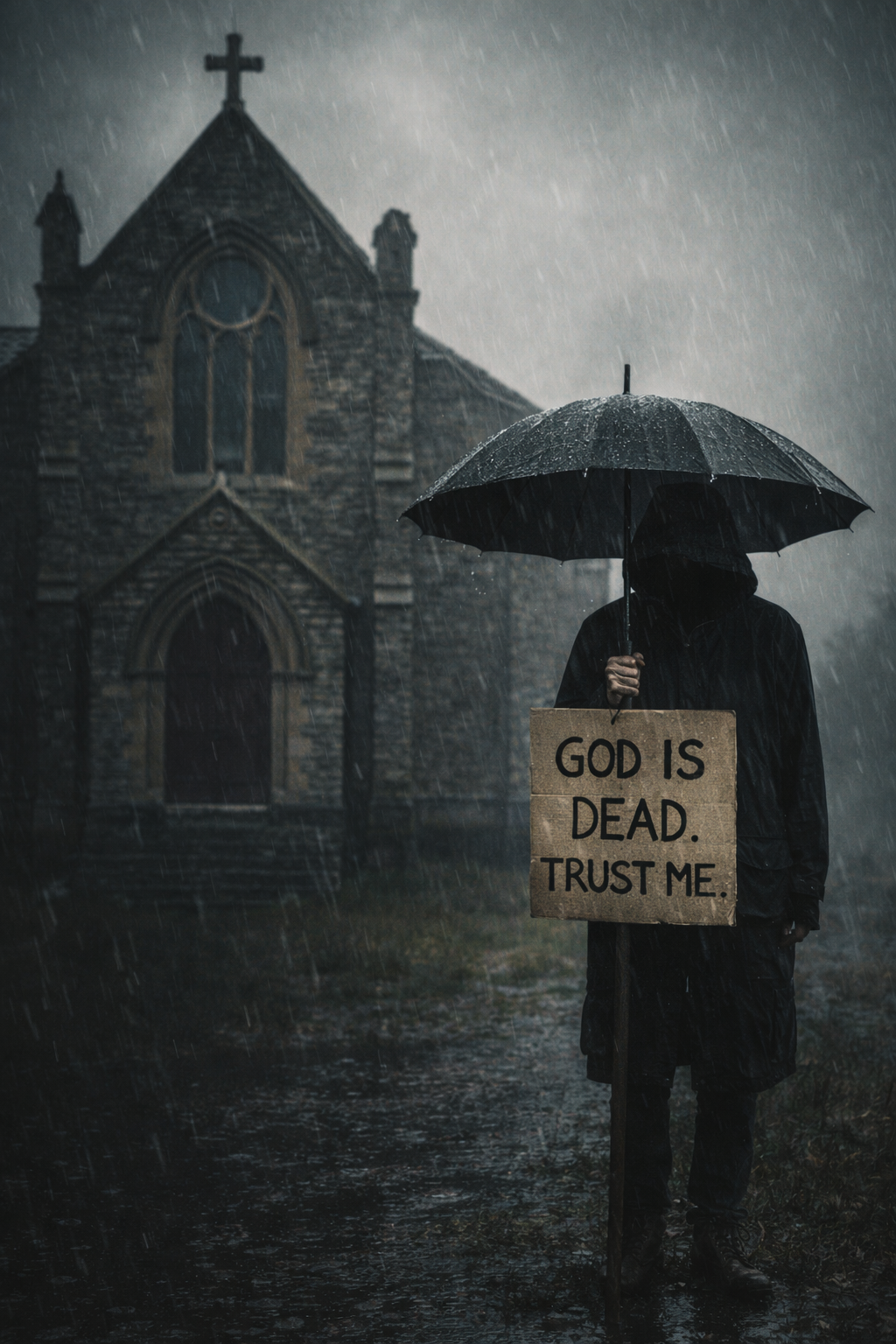
Peter Berger's classic sociological work The Sacred Canopy (1967) argues that religion functions as a social apparatus of meaning. Human beings, he suggests, cannot live without "nomos" — a meaningful order that renders the world coherent. Religion, in his framing, is the symbolic shelter that societies construct to protect themselves against the threat of chaos and meaninglessness. He writes, "Religion is the audacious attempt to conceive of the entire universe as being humanly significant." The "sacred canopy" thus describes the shared cultural architecture that allows individuals to inhabit the same reality, to live under the same story.
Rudolf Otto, writing a half-century earlier in The Idea of the Holy (1917), turns attention away from the social function of religion toward the experiential core of the sacred. His concept of the numinous names the irreducible feeling at the heart of religious life — what he calls mysterium tremendum et fascinans: the holy as simultaneously overwhelming, terrifying, and fascinating. Where Berger emphasizes religion's role in stabilizing societies, Otto emphasizes religion's roots in destabilizing experiences of awe, dread, and enchantment.
Both perspectives remain vital. Otto identifies the primal encounter that drives human beings to seek orientation. Berger identifies the social structures that emerge in response. Yet neither fully explains the contemporary religious landscape often described as "spiritual but not religious." This is where the metaphor of umbrellas becomes illuminating. As Hannah Vaughan-Spruce notes, in pluralist societies, people inhabit "multiple plausibility structures, more like sacred umbrellas than a canopy." Rather than sheltering beneath a single canopy, many individuals today insist on holding their own umbrellas — personalized spiritual practices, curated sets of beliefs, idiosyncratic rituals. These umbrellas are both a rejection of institutional religion and a recognition of the same underlying need for shelter from chaos.
Reframing Berger and Otto through a Cosmology of Dust to Diamonds
My own cosmological framework, which I call Dust to Diamonds, provides a way to situate both Berger's canopy and Otto's numinous within a larger theory of consciousness. Here, I draw on cognitive scientist Donald Hoffman, who argues in The Case Against Reality (2019) that what we perceive as reality is, in fact, an interface—a kind of headset that evolved not to show us the truth but to help us survive. Perception, in his framing, is not a window on the world but an adaptive layer that hides complexity and guides behavior. In my usage, the headset refers to this stabilizing interface: the layer that narrates a linear timeline, manages the self, and resists dissolution to preserve coherence.
Against this stabilizer stands what I call the Field — the deeper layer of reality from which meaning emerges. The headset corresponds to what Berger describes as the socially stabilized self, the conscious driver kept aligned with others under the canopy. The Field, however, is remembered unconsciously: it is accessed through dreams, myth, and ritual, where symbolic codes compress infinite meaning into packets that can survive translation into human consciousness.
The question this raises is important: if both the canopy and the headset are actively constructing reality rather than simply reflecting it, what exactly are they made of? Philosopher and physicist Karen Barad helps here. Her work insists that the frameworks and practices we use to observe the world don't just describe phenomena, they participate in producing them. This is a crucial clarification for Dust to Diamonds. Both canopy and headset function this way: they are not neutral filters but active constructors of worlds. Myth, by contrast, is not reducible to apparatus; it is the symbolic code that the Field compresses into packets, the raw potential out of which apparatuses weave stability.
Otto's numinous, in this light, can be understood as the moment when the headset briefly dissolves and Field-awareness floods in. The trembling terror of tremendum is the conscious mind's panic at losing its stabilizing narrative. The fascination of fascinans is the unconscious recognition that the Field is the deeper ground of identity. It is the only thing that cannot be lost. Otto is correct to name this irreducible, destabilizing encounter, but Dust to Diamonds reframes it as an encounter with the underlying architecture of consciousness itself, rather than a freestanding "category" of experience.
Berger's canopy, in these same terms, is the apparatus that tunes headsets to the same station of reality. It stabilizes meaning across individuals, weaving mythic packets into institutions so that numinous breaches do not fragment society into chaos. Berger rightly observes that religion functions to maintain order, but within my cosmology, this is not religion's ultimate essence. Rather, religion is a culturally specific form of canopy-weaving, dependent on mythic material drawn from the Field. Religion does not create the numinous; it domesticates and interprets it.
The proliferation of umbrellas in contemporary spirituality, then, is the natural outgrowth of pluralism in a world where the shared canopy has fractured. Dust to Diamonds interprets this as the collision of two forces: the unconscious memory of the Field, which makes every person crave symbolic orientation, and the modern suspicion of collective headsets, which makes individuals resistant to shared canopies. In effect, spirituality today reflects both canopy-hunger and canopy-allergy. The umbrella is a personal stabilizer, small enough to maintain autonomy but still attempting to perform the same function that canopy once did.
Toward a Unified Account
The Dust to Diamonds cosmology allows us to integrate Berger and Otto into a single continuum. Otto's numinous is the raw experience of headset dissolution. Berger's canopy is the collective structure that regulates and interprets those experiences. Vaughan-Spruce's umbrella is the modern fragmentation of the canopy into individualized apparatuses. All three make sense when situated within the deeper logic of human consciousness as simultaneously narrative-bound (headset) and Field-facing (unconscious myth).
Religion, in this view, is not opposed to myth but rather its child: a socially organized mode of myth that stabilizes numinous encounters. Spirituality, in turn, is the attempt to reclaim myth and numinous encounter outside the authority of religion's canopies. By seeing these dynamics through the Dust to Diamonds cosmology, we can better understand why the sacred continues to matter even as the old shelters collapse.
References
Barad, Karen. Meeting the Universe Halfway: Quantum Physics and the Entanglement of Matter and Meaning. Durham, NC: Duke University Press, 2007.
Berger, Peter L. The Sacred Canopy: Elements of a Sociological Theory of Religion. Garden City, NY: Doubleday, 1967.
Hoffman, Donald D. The Case Against Reality: Why Evolution Hid the Truth from Our Eyes. New York: W.W. Norton, 2019.
Otto, Rudolf. The Idea of the Holy. 1917. Translated by John W. Harvey. Oxford: Oxford University Press, 1958.
Vaughan-Spruce, Hannah. From Sacred Canopy to Sacred Umbrellas: Cultural and Missiological Implications of Multiple Plausibility Structures. Twickenham: St Mary's University, 2021.
Yvé Dizes is the founder of HUM School of Mysticism and The Spiritual Concierge. Her academic work explores consciousness, relational ethics, and the cultural politics of spiritual practice.