

"I" Is Killing "Us": What Western Spirituality Gets Wrong
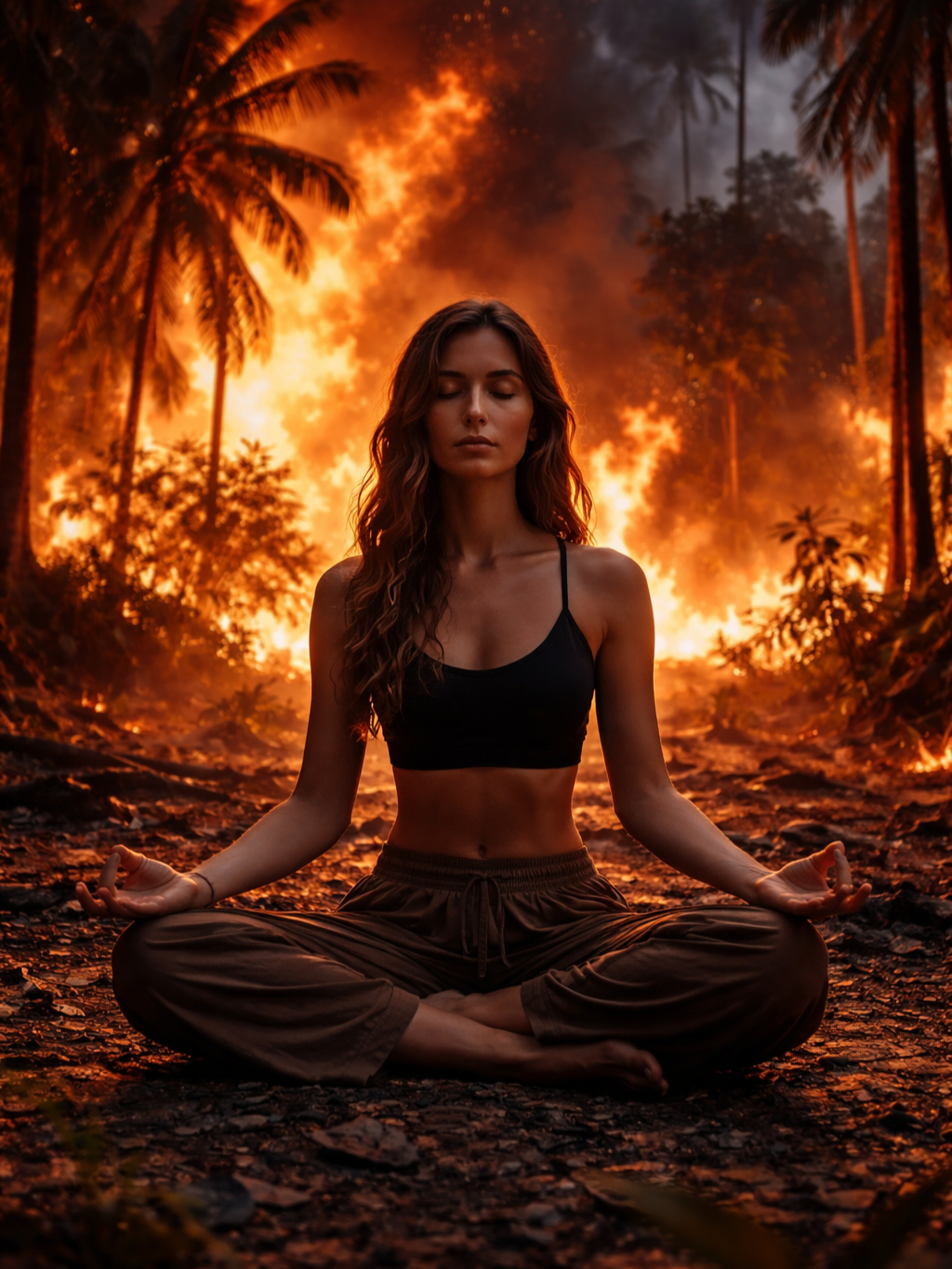
A woman sits meditating in front of a burning rainforest.
Image is AI-generated.
Western spiritual communities have a problem — and it's one we don't talk about enough.
The practices many of us love — meditation, plant medicine, energy healing, sacred ceremony — are increasingly being consumed in ways that harm the very traditions they come from. We appropriate rituals outside of our ancestry, extract resources from developing countries, and when someone points this out, the community often lacks the tools to step outside of what feels right and consider the larger picture.
And it goes deeper than that. The same individualism driving these choices has become a gateway to something more troubling. In 2011, British sociologists Charlotte Ward and David Voas coined the term conspirituality to describe exactly what we're seeing now: a fusion of conspiracy theories and New Age spirituality, where personal empowerment narratives blend seamlessly with beliefs in hidden forces and suppressed truths. If you've spent any time in spiritual circles lately, you've likely felt this pull — the way wellness culture and right-wing conspiracy have become surprisingly comfortable neighbors.
This isn't a fringe issue. It's not a few bad apples. It's a pattern, and it has consequences: it erodes trust, damages social cohesion, silences indigenous voices, and slowly strips spiritual practice of its ethical foundation.
Why the obvious solutions fall short
Some argue we need standardized certifications for spiritual practitioners — guardrails to keep the space accountable. And while the impulse is understandable, the spiritual community is decentralized by nature, and certification programs risk excluding the very marginalized voices we need most. Others point to the healthcare system: when people distrust medicine, they're more likely to fall into conspiratorial thinking. True, but systemic healthcare reform is a generational project, not a solution for today.
What can actually move the needle
What I believe can shift things — and shift them now — is culture change. Specifically, a shift in what feels good.
We live in what I'd call vibe culture. People don't just adopt ideas; they adopt identities. The reason conspirituality spreads isn't because people are foolish — it's because it feels empowering. It makes people feel special, chosen, awake. If we want to counter it, we need to make ethical, community-centered spirituality feel just as compelling. Just as countercultural. Just as alive.
The Kamala Harris 2024 campaign showed us what's possible when culture and influence align around a shared feeling. After Taylor Swift posted a link to Vote.gov, over 400,000 people visited the site in 24 hours. Social movements like #MeToo and #BlackLivesMatter didn't just raise awareness; they changed the conversation permanently because they made people feel part of something real and urgent.
Spirituality needs that same energy — not to go viral for the sake of it, but to genuinely shift what people believe spiritual practice is for. Not a tool for personal optimization. Not a path to individual ascension. But a way of showing up more fully for each other and for the world.
The "I" was never the whole story
My academic work on consciousness and relational ethics keeps returning to the same observation: attention, when cultivated honestly, leads us toward others, not away from them. It builds the kind of discernment that makes us harder to manipulate and more capable of genuine community.
The "I" will always be part of spiritual practice. But it was never meant to be the whole story.
Sources
Ward, Charlotte, and David Voas. "The Emergence of Conspirituality." Journal of Contemporary Religion, vol. 26, no. 1, 2011, pp. 103–121.
Meltzer, M. "QAnon's Unexpected Roots in New Age Spirituality." The Washington Post, 29 Mar. 2021.
Plante, T. G. "Religious and Spiritual Communities Must Adapt or Die." Religions, vol. 15, no. 7, 2024.
Gibson, C. "More Than 300,000 Clicks on the Vote.gov Link Posted by Taylor Swift." The National Memo, 12 Sept. 2024.
Yvé Dizes is the founder of HUM School of Mysticism and The Spiritual Concierge. Her academic work explores consciousness, relational ethics, and the cultural politics of spiritual practice.